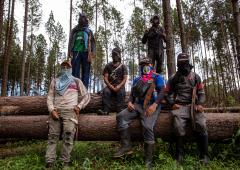
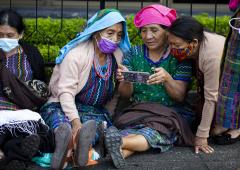
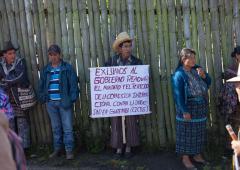
On April 9, Colombians commemorated the nation’s first Victims Day with public events and activities across the country. This photo essay is a series of images of the commemorative events in Bogotá, as well a memory gallery titled "We Are Land" that represents victims’ interpretations of the violence they have endured during the country’s conflict.
Just over two decades since the end of the Contra war in Nicaragua, U.S. photographer Paul Dix captures the war's enduring legacy for Nicaraguans. This photo essay showcases a collection of pictures from the new book "Nicaragua: Surviving the Legacy of U.S. Policy," by Paul Dix and Pamela Fitzpatrick.
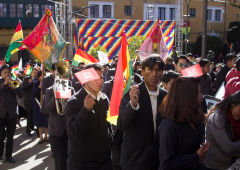
On October 21, Bolivian President Evo Morales agreed to scrap a controversial plan to build a highway through the TIPNIS reserve. His decision came just two days after over 1,000 indigenous TIPNIS protesters arrived in La Paz after marching 370 miles against the highway project. This photo essay looks at some of the defining moments of the two-month-long TIPNIS march.
Outside the windows above the telephones, the tree-lined street leads out to fields at the foot of cloud-topped hills. San Jose, at the edge of a valley an hour south of Oaxaca's capital city, is a pretty town. But this seemingly peaceful environment is deceptive. Since a mine began operating nearby, residents passing in the road view each other with suspicion.
Cubans see their urban agriculture movement as a possible solution as the world begins to grapple with increasing prices and demand for food and fuel. Many other countries have begun to use the Cuban experience as a model as locally grown, organic produce becomes more popular worldwide.
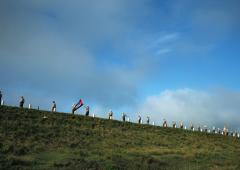
In the late 1990s, Oaxacan artist Alejandro Santiago set to repopulate his town with 2,500 individual human sculptures, each representing a person who had left San Pedro Teococuilco to migrate elsewhere. Right now these sculptures are alive in the streets of Oaxaca city, documenting a strong sense of pain that rarely makes it into comprehensive immigration debates in the United States.
In Oaxaca, Mexico, 76% of the population lives in poverty. In order to flee this dire situation, about 250,000 Oaxacans migrate north each year. Close to 1.5 million now live in the United States. These statistics and more were brought to life on a recent trip to Oaxaca.
Since April 15th, members of the P’urhépecha indigenous community of Cherán, Michoacán have self-organized community defense committees to protect themselves from violence amidst Mexico’s drug war. On June 26th a small caravan set off from Cuernavaca, Morelos to bring food supplies to Cherán, to show support for the community, which is both suffering from and resisting the drug war model imposed by Mexican president Felipe Calderón soon after he took office in 2006.
On June 10, a new movement was born in Mexico. A peace caravan of hundreds of people from all over the country arrived to the border city of Ciudad Juárez to sign a national social pact with the goal of ending the militarized drug war in Mexico. This drug war has killed approximately 40,000 people since Mexican president Felipe Calderón took office in December 2006. This pact was appropriately signed in brutalized Ciudad Juárez, an epicenter of drug war-related violence, where 7,000 of these killings have taken place.
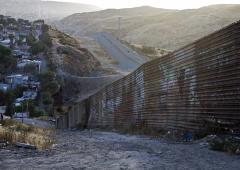
From May 30 to June 5, I participated in the Migrant Trail Walk, a 75 mile walk from the U.S.-Mexico border to Tucson, Arizona, traversing the Altar Valley, one of the hottest stretches in the Sonoran desert during the summer months. This eighth annual walk was done in solidarity with the thousands of migrants who cross into the United States clandestinely, and in remembrance of the thousands whose bodies have been recovered, many in the same vast desert where we walked.
On November 28 Haitians went to the polls to vote for a new president. However, while the Organization of American States and the Caribbean Community (CARICOM) validated the elections, other observers have documented that the voting process was rift with irregularities. The following photos question the election's legitimacy, especially with so much at stake in a country in desperate need of reconstruction after the January 12 earthquake.
Voters in El Salvador took the first step on March 15 toward turning the tide against 130 years of conservative rule over the country by electing Mauricio Funes of the leftist Farabundo Martí National Liberation Front (FMLN) party as president. The FMLN's resilience and persistence has finally paid off. But after nearly three decades of struggle – on the battlefield, in the streets, and at the ballot box – the political forces that make up the FMLN now face perhaps their greatest challenge: governing.
The third Americas Social Forum (ASF) took place in Guatemala City from October 7 to 12, 2008. Thousands of people and organizations, from every corner of the American hemisphere, gathered in the campus of the University of San Carlos, Guatemala, to participate, debate, exhibit, network, and develop progressive alternatives. As usual for any World Social Forum event, the ASF process in Guatemala was not without internal debates.